Custom fields overview
Last updated July 1, 2026
You can create custom fields for many objects, such as sites, meters, and accounts. Custom fields let you track extra details and upload important documents or images for your organization.
Custom fields also let you build your own groups, which you can use in reports and dashboards.
Standard and advanced custom fields
- Standard custom fields are managed in the application or with setup spreadsheets.
- Advanced custom fields, which let you store more complex information, can only be managed in the application.
Manage custom fields
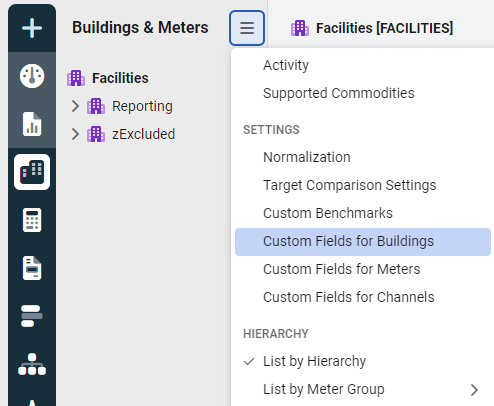
Access custom fields from the module menu of the object you want to update.
Custom fields are available for:
- Sites
- Meters
- Channels
- Energy Projects
- Accounts
- Vendors
- Rate Schedules
Spaces are not included. Custom fields cannot be added to spaces.
Types of custom fields
EnergyCAP supports two categories of custom fields. Standard custom fields cover common data types and can be managed in the application or with setup spreadsheets. Advanced custom fields support richer content like images and documents and can only be managed in the application. See the table below for all types and examples.
Mark custom fields as important
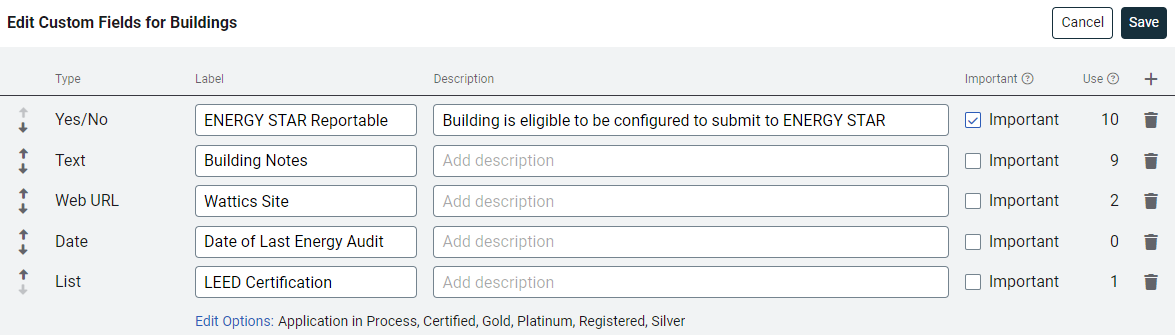
Marking a custom field as important helps you and others quickly spot when a value is missing.
Note: Marking a field as important does not make it mandatory.

Any important custom field that is missing a value is shown on the Properties tab. Use the Add value link to quickly add the missing information.
Custom field descriptions
Add descriptions to custom fields to help others know the purpose for the custom field. A tooltip is available for custom fields when the description is entered.

Custom fields explained with examples
| Custom Field | Information | Example |
| Yes/No | A simple Boolean question | Is this building leased? |
| Integer | A question expecting a numeric answer | District number for this building? |
| Text | Enter free form text | County location for the building? |
| Decimal | Enter a numeric value with up to four decimals | What is the average ceiling height? |
| Date | A question expecting a date answer | Meter install date? |
| List | Create a question and provide a drop-down of answers |
What is the LEED certification level for this building? |
| Web URL | Enter a specific URL | For example, https://www.energycap.com/helpcenter/releasenotes |
| Advanced custom fields - can only be managed in the application | ||
|
Formatted text |
Add HTML formatting and links | Add formatted lists or links to documents. |
| Image | Upload an image | A picture of the building or where a meter is located. |
| Upload a PDF file | Add workflow instructions, forms, or contracts. | |
| Document | Upload documents | Add workflow instructions, forms, or contracts. |
| JSON | Add important configuration information | Save formatted information for use by developers to enhance your workflow and integrate more easily with other systems. |
Real-world examples
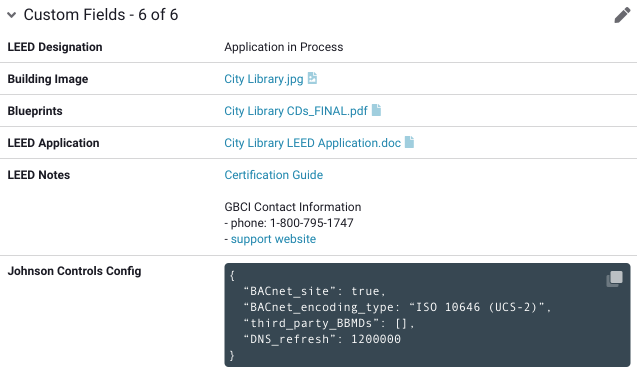
Here are common ways organizations use custom fields:
- LEED Designation - list
- Building image - image
- Blueprints - document
- LEED Application - document
- LEED Notes - formatted text
- Johnson Controls Config - JSON
Using custom fields in groups
Custom fields let you build your own groups when a pre-built group doesn't meet your needs. Create the custom field, populate it for each site or meter, and then create an automatic group using the custom field as a filter. The group can then be used as a filter in reports and dashboards.
Select the filter Meter group or Site group, select the operator, and choose the group you created.
