Dashboards overview
Last updated September 22, 2026
Dashboards give you quick visual insights into your utility bill data. They highlight key metrics from your bills so you can monitor performance, spot trends, and make informed decisions.
When you sign in to EnergyCAP, you are taken to the first dashboard in your My Dashboards list. This landing page is fixed and cannot be changed.
You cannot pin a site to your dashboard page but you could build a dashboard with widgets that report on one specific site.
You cannot print a dashboard, but you can download the data from each individual widget.
Key features
Customize
Create dashboards tailored to specific departments or divisions in your organization.
Sample dashboards
These use your real data to highlight reporting features. Use them as a starting point to refine filters and build your own views.
Role-based access
What you can do depends on your user role, such as:
- Sharing dashboards
- Editing a shared dashboard
- Making dashboards public
Personal dashboards
Each user can create their own private dashboards to track what matters to them.
Step-by-step article on creating a sample dashboard.
Best practices
- Keep dashboards focused on a single goal.
- Limit the number of widgets to avoid clutter.
- Use clear titles and labels.
- Apply consistent date ranges across widgets.
- Highlight key metrics at the top.
Troubleshooting
Data not appearing
- Check filters and date range.
- Confirm the data source is correct.
Widget looks incorrect
- Review grouping and aggregation settings.
Dashboard is slow
- Reduce the number of widgets.
- Limit large data queries.
Dashboard toolbar

- The description (click the help icon) gives you details about why the dashboard was made.
- Tags let you know when the dashboard is public or shared with a user group. You can hover over each for more details.
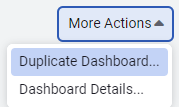
- More Actions lets you copy or duplicate a dashboard.
- Use the Share option to make a dashboard public or share with one or more user groups.
- Add Widget lets you add more content to your dashboard.
Duplicate a dashboard
Don't want to start a dashboard from scratch? You can save time and duplicate a dashboard and then update the widget filters.
Dashboard details
It's helpful to your viewers to enter a description when you build a dashboard. With dashboard details you can help viewers understand what information is presented on the dashboard, who created it, and when it was updated.

Share with user groups
- When you have the appropriate permissions, you can share a dashboard with one or more user groups or the public.
- When a user is made inactive all their shared items are still available, however, an administrator may change or disable the shared dashboard.

Share with the public
In addition to sharing the dashboards with user groups you can also share the dashboard with people who don't have a login. You have two options when sharing a public dashboard.
How to configure a public dashboard
You can embed public dashboards and maps in other websites or share them with a direct link.

Public access settings for dashboards
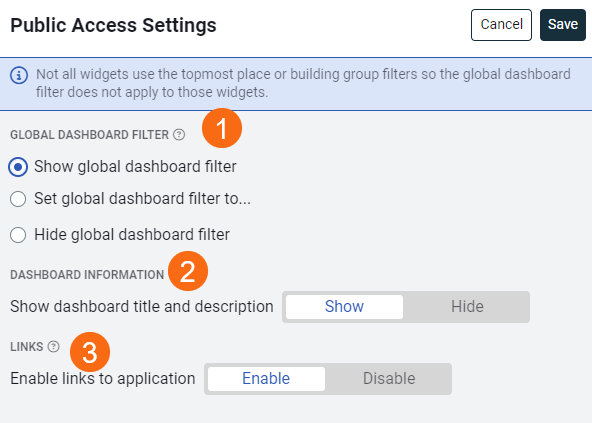
1. Global dashboard filter
- Show global dashboard filter.
- Make the global filter visible and let the viewer update the filter. - Set global dashboard filter...
- Lets you configure the filter and doesn't let the viewer make any updates. The filter is hidden from view. - Hide global dashboard filter
- The filter is not set and is hidden from view.
2. Dashboard information
Decide if you want to show the dashboard title and description.
3. Links
You can decide if you want the building and meter links in your dashboard to be active or not.
It is helpful to disable links to public dashboards because viewers won't have login credentials.
This does not affect any links in the Text and HTML widget.